Sailing the Bay of Biscay: A Coruña to Gosport Expedition
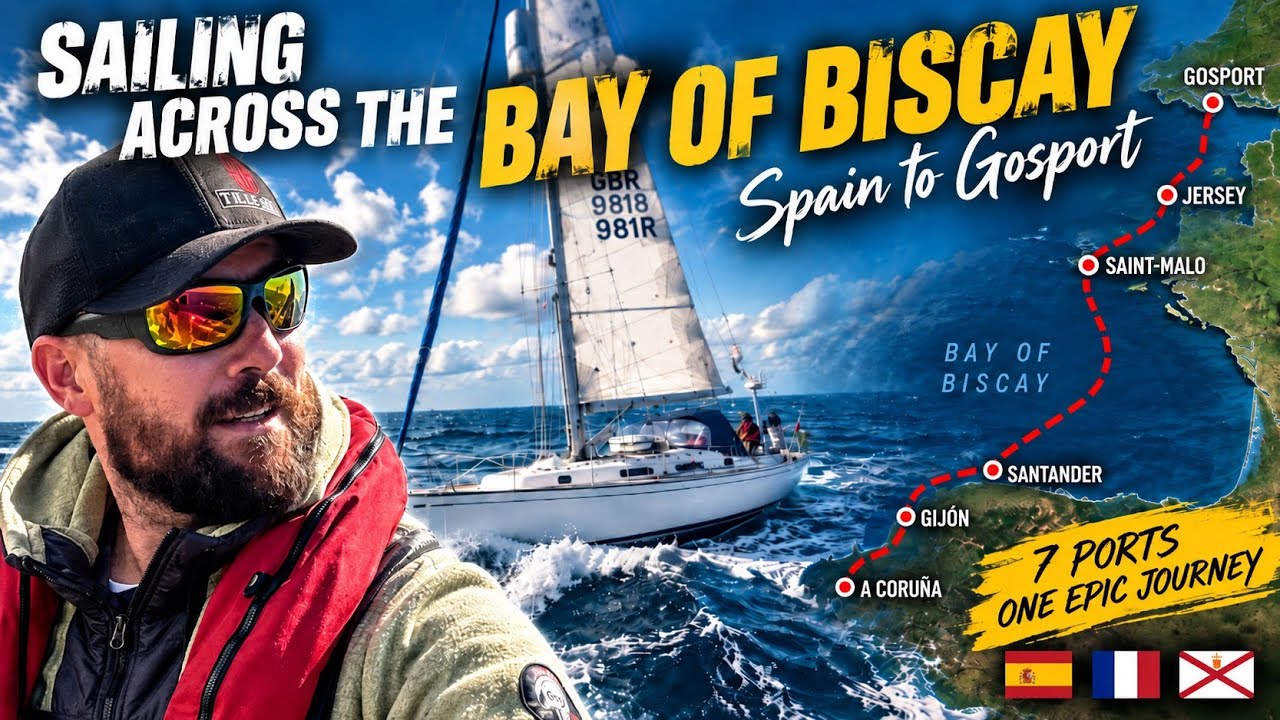
Nine people. Seven major stops. One sailing expedition from northern Spain to the south coast of England.
We started in A Coruña on the north-west coast of Spain and finished in Gosport, after sailing along the northern Spanish coast, crossing the Bay of Biscay, continuing around Brittany, visiting Jersey and finally crossing back to England.
For me, this expedition was about more than getting from one port to another. It meant stepping into an environment where I still had plenty to learn, working as part of a nine-person crew and taking responsibility during long passages and night watches.
Most of my background is built around survival, fieldcraft, expeditions and operating on land. Sailing forced me to learn a different system completely. That was exactly what made it worth doing.
Watch the full sailing expedition
Watch the full A Coruña to Gosport sailing expedition on YouTube.
The route: A Coruña to Gosport
Our route took us through a mixture of Atlantic coastline, open-water passages, French ports and the Channel Islands.
- A Coruña, Spain
- Gijón, Spain
- Santander, Spain
- Brest, France
- Saint-Malo, France
- Jersey
- Gosport, England
Every leg felt different. Some sections were about enjoying the coastline and building confidence. Others demanded more concentration, longer watches and much more respect for the conditions around us.
Nine people living and working on one boat
There were nine of us on the expedition.
That matters because a sailing expedition is not an individual challenge. The boat only works properly when the crew works properly.
People need to communicate, share watches, manage fatigue, keep an eye on the weather and navigation, deal with food and equipment, and still live together in a relatively confined space.
Anyone who has spent time on expeditions will recognise that dynamic. When people are comfortable and rested, communication is easy. When people are tired and the boat has been moving for hours, small frustrations can become much bigger if the team does not stay switched on.
That was one of the things I enjoyed most. The environment was different from the survival challenges I am used to, but the principles around teamwork, discipline and looking after the people around you were very familiar.
Starting the expedition in A Coruña
A Coruña was the point where the journey became real.
There is always a difference between planning an expedition and actually leaving the harbour. Once the coastline starts disappearing behind you, the conversations change. The next port, the weather, the sea state and the boat become the priority.
From A Coruña we began working our way east along the northern coastline of Spain towards Gijón and then Santander.
Northern Spain from the water is impressive. It is rugged, exposed and very different from the image of Spain most people associate with package holidays and Mediterranean beaches.
A Coruña to Gijón and Santander
The early legs gave us time to settle into the boat and into the rhythm of the expedition.
That rhythm becomes important. Meals happen around the boat rather than the other way around. Sleep is broken around watches. Weather can change plans. A simple task takes more concentration when the deck is moving underneath you.
By the time we reached Santander, the next stage was hanging over us.
The Bay of Biscay.
Crossing the Bay of Biscay
The Bay of Biscay is one of the best-known stretches of water in Europe, and crossing it was one of the defining parts of our expedition.
For us, the route would take us from northern Spain towards Brest in France.
This was the part where the expedition stopped feeling like a sequence of coastal stops and became a proper passage.
Longer periods at sea mean fatigue has to be managed properly. Watches become critical. You cannot simply decide you have had enough for the day and stop.
The boat keeps moving, which means the crew keeps operating.
Night watches and responsibility at sea
One of the strongest memories I have from the journey is sailing at night while other members of the crew were sleeping.
The sea feels completely different in darkness.
During the day, you can see the horizon and watch conditions develop around you. At night, the visual world shrinks. You become far more focused on navigation, instruments, lights, sound and what the boat is doing underneath your feet.
There is also a different level of responsibility when you know other people are asleep.
Eight other members of the expedition are relying on the people who are awake to remain alert and do their job properly.
I found that pressure useful. It forces concentration. There is no room for drifting mentally because the rest of the team depends on you staying switched on.
What sailing taught me about being a beginner again
I have spent a large part of my adult life learning and teaching survival skills, navigation, fieldcraft and operating in difficult environments.
That experience helps, but it can also make it easy to stay inside areas where you already feel competent.
Sailing put me back into learner mode.
There was new terminology, new equipment, different procedures and a completely different relationship with the environment.
I think that is important.
Adventure should not always be about demonstrating the skills you already have. Sometimes the best move is to deliberately enter an environment where you have to listen, learn and build new capability.
That is uncomfortable, but useful.
You can read more about my wider background in survival and extreme environments on my About Steven Kelly and TV Survival Expert pages.
Arriving in Brest
After the Biscay crossing we reached Brest in Brittany.
Getting back onto dry land after a longer period at sea gives you a new appreciation for normal things. Walking without the floor moving is suddenly noticeable. So is a proper meal and the chance to reset before the next leg.
But Brest was not the finish.
We still had the Brittany coast, Saint-Malo, Jersey and the final run to Gosport ahead of us.
Brest to Saint-Malo
From Brest we continued around the French coast towards Saint-Malo.
By this stage the crew had settled much more deeply into the routine. Watches, movement around the boat and everyday jobs become increasingly automatic as an expedition continues.
Saint-Malo was another major checkpoint and one of the most memorable ports on the route, but again we were only passing through.
The Channel Islands were next.
Saint-Malo to Jersey
From Saint-Malo we sailed north to Jersey.
Reaching Jersey felt significant because Britain was now getting much closer, but it would have been easy to mentally finish the expedition too early.
That is something I have learned repeatedly in survival and expedition environments: the objective is not complete until it is actually complete.
We still had one final leg to sail.
Jersey to Gosport.
The final leg from Jersey to Gosport
Leaving Jersey meant beginning the last section of the expedition and heading for the south coast of England.
By that point we had travelled from Galicia, along northern Spain, across Biscay, around Brittany and through the Channel Islands.
Seeing the British coastline ahead brought the whole route together.
Eventually we reached Gosport and the expedition was complete.
There is always a strange moment at the end of a journey like this. For days, every decision has been about the next watch, the next port or the next problem. Then suddenly the objective has been achieved.
Part of you is ready for normal life again. Another part is already thinking about the next expedition.
What I took from the expedition
This trip reinforced a few lessons that apply far beyond sailing.
- Stay teachable. Experience in one environment does not make you an expert in another.
- Teams matter. Nine people living and working together need clear communication and shared responsibility.
- Fatigue changes performance. Night watches and long passages punish poor routines.
- Systems beat improvisation. Good procedures reduce the number of decisions you have to make when tired.
- Finish the mission. Jersey felt close to home, but Gosport was the actual end point.
Those lessons are familiar from military life, survival television and expeditions. Sailing simply delivered them in a new environment.
Would I do another sailing expedition?
Yes.
The biggest attraction was not pretending I was already a sailor. It was learning a new skill set while being part of a proper journey with a clear objective.
That combination of movement, uncertainty, responsibility and teamwork is exactly what I look for in an expedition.
I would absolutely take on another one.
Watch the full A Coruña to Gosport expedition
The full expedition video includes the route through Spain, the Bay of Biscay crossing, France, Jersey and the final leg into Gosport.
Watch the full sailing expedition on YouTube.
If you enjoy survival, adventure and expedition content, subscribe to my YouTube channel and follow the next journey.
About Steven Kelly
Steven Kelly, also known as Survival Ste, is a British TV survivalist, former 29 Commando Regiment soldier, professional survival instructor, adventurer and founder of South West Survival.
His television credits include Discovery's Naked and Afraid and Naked and Afraid: Apocalypse, Naked, Alone and Racing to Get Home and the BBC's Bear Grylls: Wild Reckoning.
For television, speaking and media enquiries, visit the Speaking & Media Enquiries page.
7 Skills That Kept Me Alive on Naked and Afraid
Get the free guide, plus new journal posts and podcast episodes when they drop. Written by me, not an algorithm.
No spam. Unsubscribe any time.