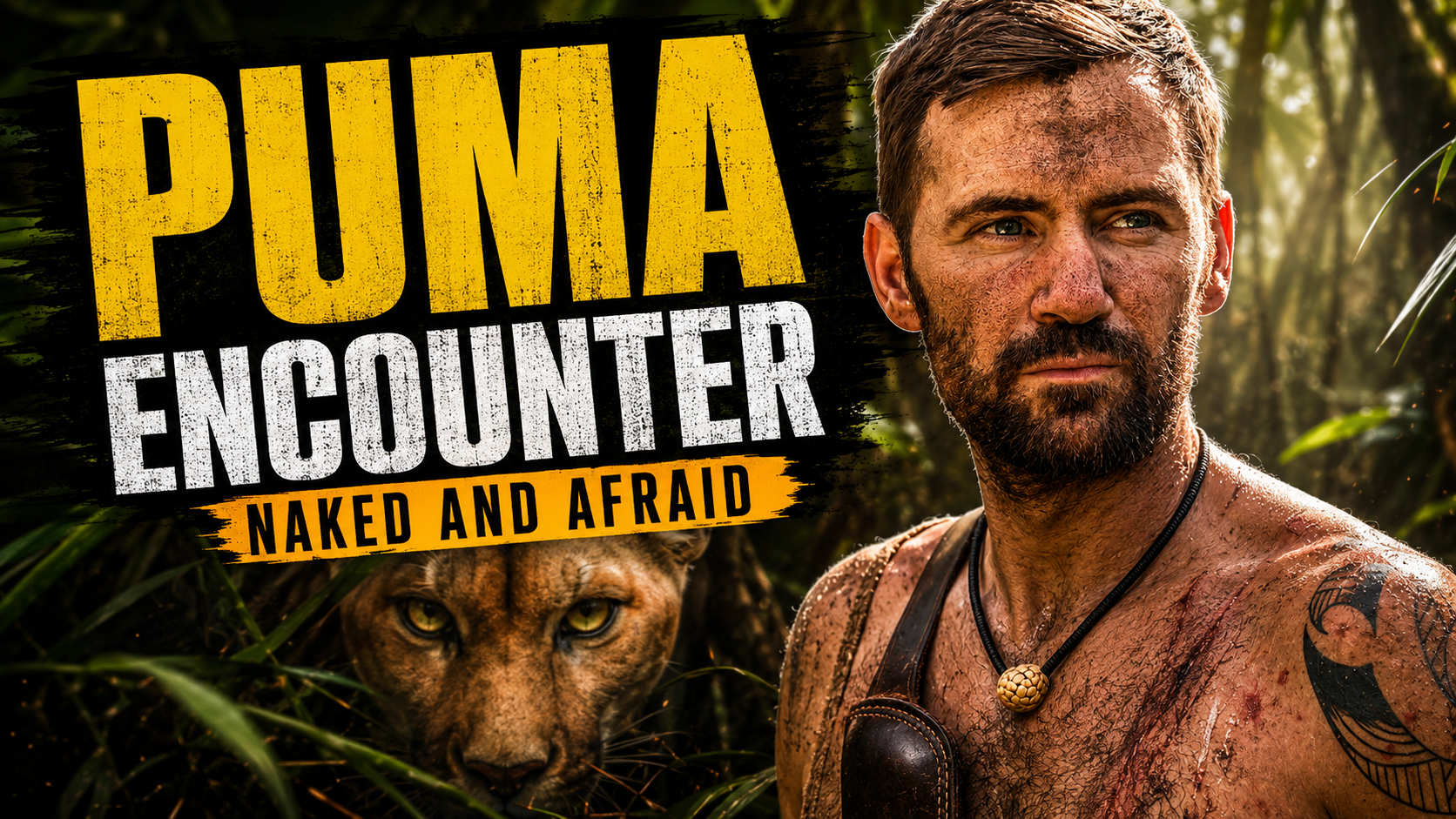
Puma Encounter on Naked and Afraid: What It Felt Like in the Colombian Jungle
There are moments on Naked and Afraid that look intense on television.
Then there are moments that feel completely different when you are the one lying there, hungry, exposed, covered in bites, trying to sleep in the jungle while something powerful is moving nearby.
The puma encounter in Colombia was one of those moments.
I was already under pressure. The Colombian jungle is not a comfortable place to exist. It is hot, wet, loud, crawling with insects, and it never really lets you switch off. You are constantly listening, constantly scanning and constantly trying to work out what is normal jungle noise and what is a genuine threat.
Then you hear something outside camp.
That changes everything.
Watch the Puma Encounter Debrief
You can watch the full YouTube breakdown here:
https://youtu.be/wrrBVXqKD0I?si=qm6rmQbj-VvJp0EF
In this video, I break down what was going through my head during the puma encounter, what viewers do not always see on survival TV, and why staying calm matters more than trying to act tough.
What Happened During the Puma Encounter on Naked and Afraid?
During my Naked and Afraid challenge in Colombia, there was a moment where we believed a puma was close to camp.
That might sound dramatic, but when you are actually there, the danger is not theatrical. It is simple.
You are vulnerable.
You have no clothing, no proper shelter, limited energy, limited food, and very little margin for error. You are not watching wildlife from a vehicle or from behind a fence. You are lying in its environment, trying not to become the weakest thing in the area.
That is the part people at home often miss.
On television, a predator encounter becomes a tense clip.
In real survival, it becomes a calculation.
Where is it?
How close is it?
Is it moving towards us?
Is our fire strong enough?
Are we making enough presence?
Is panic going to make this worse?
You cannot afford to overreact, but you cannot ignore it either.
Why the Jungle Feels Different at Night
The jungle changes at night.
During the day, you can at least see your problems. You can track movement, read the terrain, watch where you step and use your eyes properly.
At night, your hearing takes over.
Every crack, rustle, call and movement becomes part of the mental picture you are building. Some sounds mean nothing. Some sounds matter. The problem is working out which is which when you are exhausted and your body is already running low.
That is where people start making poor decisions.
Fear is not the problem. Fear is useful. Fear tells you to pay attention.
Panic is the problem.
Panic burns energy, damages teamwork and makes you sloppy. In that moment, the priority is not to look brave. The priority is to stay useful.
What My Military Background Taught Me
My military background helped because I had spent years operating under pressure.
That does not mean you stop feeling fear. Anyone who says they do not feel fear is either lying or has never been properly tested.
What training gives you is a process.
You breathe.
You assess.
You control what you can control.
You avoid making emotional decisions.
That mindset matters in the jungle. It matters in the military. It matters in survival. And it matters in normal life when pressure starts stacking up.
The worst thing you can do in a survival situation is let your imagination outrun the facts.
You still respect the threat, but you do not let it own you.
What Viewers Do Not See on Naked and Afraid
One of the hardest parts of Naked and Afraid is that viewers only see a fraction of what is happening.
They see the big moments: the animal encounters, the arguments, the injuries, the successful catches, the emotional breakdowns.
What they do not always see is the slow pressure that builds before those moments.
The hunger.
The poor sleep.
The insect bites.
The constant damp.
The lack of comfort.
The mental fatigue.
The feeling that the environment is always working against you.
By the time something like a predator scare happens, you are not dealing with it fresh. You are dealing with it after days of stress already being loaded into your system.
That is why survival TV is harder than it looks.
Not because every second is dramatic, but because the boring, uncomfortable, grinding parts weaken you before the dangerous moments arrive.
Was the Puma the Scariest Moment?
It was definitely one of the strongest reminders that we were not in control of that environment.
That is the honest truth about survival.
You can have experience. You can have training. You can have mental toughness. But nature is not impressed by your CV.
The jungle does not care that I served 23 years in the military.
It does not care that I am a survival instructor.
It does not care that cameras are there.
You still have to make good decisions with limited resources.
That is what makes Naked and Afraid such a brutal test. It strips everything back. No kit. No comfort. No hiding behind image. Just you, your partner, the environment and the decisions you make under pressure.
The Real Survival Lesson
The lesson from that puma encounter was not “fight the predator” or “act hard for the camera”.
The lesson was control.
Control your breathing.
Control your reaction.
Control your noise.
Control the fire.
Control the camp.
Control the team dynamic.
In survival, you rarely control the environment. You control your behaviour inside it.
That is where experience matters.
Most people think survival is about big dramatic moments. It is not. It is about small disciplined actions repeated while you are tired, uncomfortable and under pressure.
That is the real game.
Why This Moment Matters for My Survival Brand
For me, this was not just a television scene. It was a lived experience that connects directly to what I now teach through South West Survival, my public talks and The Survival Debrief Podcast.
Survival is not about pretending to be fearless.
It is about building systems that stop fear turning into chaos.
That is the difference between panic and performance.
If you are interested in real survival training, outdoor resilience, military-style decision-making and behind-the-scenes survival TV breakdowns, this is exactly the type of content I will keep building.
Related Reading and Watching
For more behind-the-scenes survival content, visit:
The Survival Debrief Podcast:
www.stevenkelly.uk/podcast
You can also read more about my background as a British TV survivalist, former 29 Commando soldier and survival instructor on my website.
FAQ
Was there really a puma near camp on Naked and Afraid?
During my Naked and Afraid challenge in Colombia, there was a moment where we believed a puma was close to camp. In that environment, at night, with limited protection and low energy, that becomes a serious situation very quickly.
Are pumas dangerous to humans?
Pumas do not usually seek out humans as prey, but they are powerful predators and should always be respected. In a survival situation, the risk is not just the animal itself. It is also how tired, exposed and vulnerable you are when the encounter happens.
What should you do if you think a predator is near camp?
Stay calm, make yourself aware of your surroundings, avoid panic, keep the group together, maintain fire and presence where appropriate, and do not run blindly into the dark. Every environment is different, so the correct response depends on the animal, distance, terrain and situation.
What was the hardest part of Naked and Afraid in Colombia?
The hardest part was not one single thing. It was the accumulation: hunger, heat, insects, poor sleep, exposure, pressure and the constant need to make decisions while physically drained.
Where can I watch more Steven Kelly survival content?
You can watch more survival breakdowns, interviews and podcast episodes through The Survival Debrief Podcast at:
www.stevenkelly.uk/podcast
About Steven Kelly
Steven Kelly, also known as Survival Ste, is a British TV survivalist, former 29 Commando soldier, survival instructor and podcast host. He has appeared on Discovery Channel’s Naked and Afraid, Naked and Afraid: Apocalypse, Bear Grylls: Wild Reckoning and Naked, Alone and Racing to Get Home. He is the founder of South West Survival and host of The Survival Debrief Podcast.
Follow Steven Kelly
Facebook:
https://www.facebook.com/stevenkelly29
TikTok:
https://www.tiktok.com/@survival_ste
Apple Podcasts:
https://podcasts.apple.com/us/podcast/the-survival-debrief-podcast-with-steven-kelly/id1844233698
The Survival Debrief Podcast:
www.stevenkelly.uk/podcast
Subscribe
Want more survival breakdowns, behind-the-scenes TV stories and real-world lessons from the field?
Subscribe for updates, new podcast episodes, survival articles and training content from Steven Kelly.
7 Skills That Kept Me Alive on Naked and Afraid
Get the free guide, plus new journal posts and podcast episodes when they drop. Written by me, not an algorithm.
No spam. Unsubscribe any time.