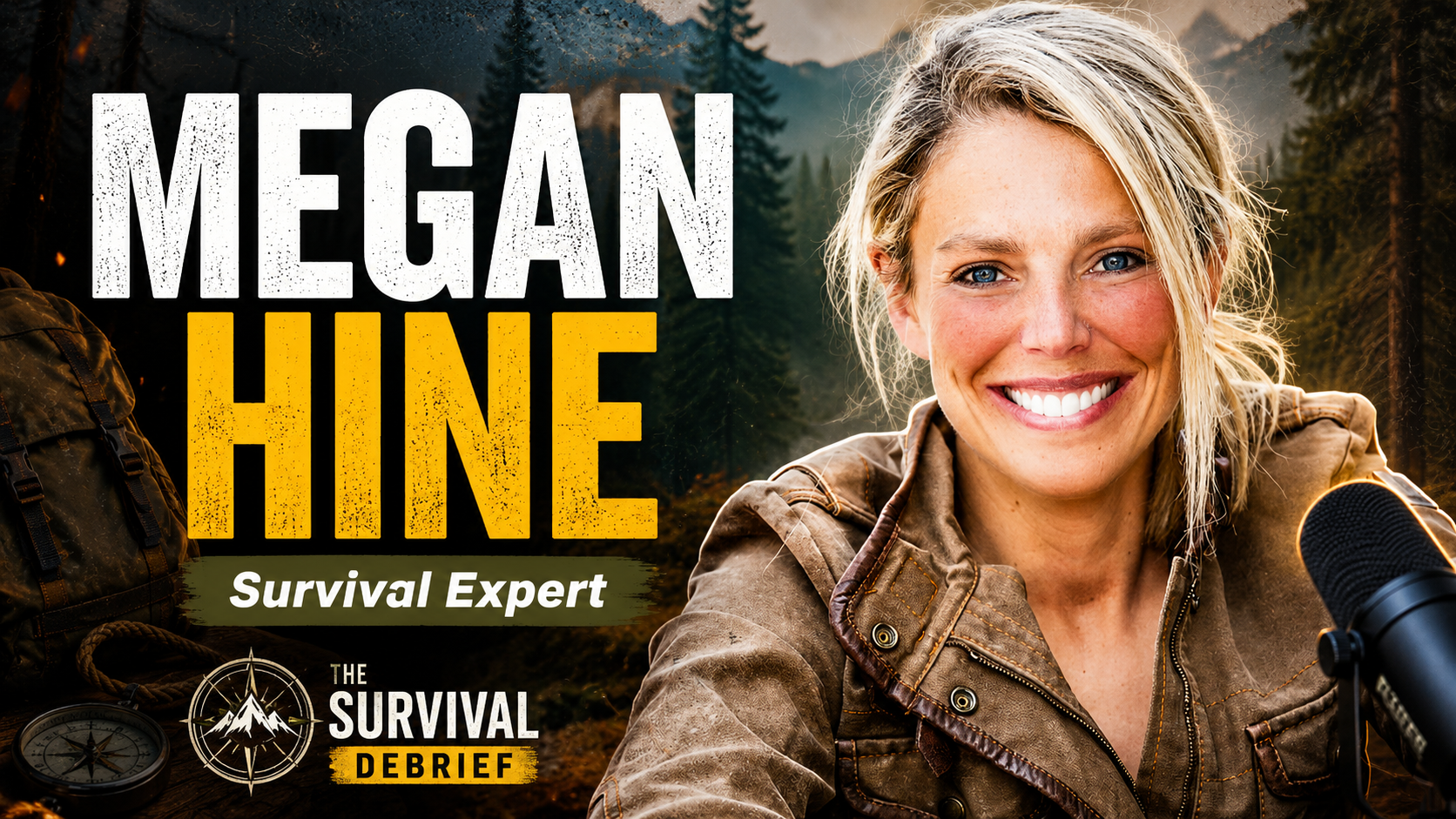
Megan Hine Interview: Bear Grylls, Survival Psychology & the Reality of Survival TV
What separates someone who knows bushcraft from someone who can genuinely survive when everything starts going wrong?
That question sits at the heart of my latest conversation on The Survival Debrief Podcast with Megan Hine, a survival consultant, wilderness guide, expedition leader and TV producer with more than 20 years in the outdoor and survival industry.
Megan has built a career working in demanding environments around the world, from expedition leadership and bushcraft to television production, remote safety and risk management. She also spent 13 years travelling internationally as part of the team behind Bear Grylls productions.
This episode goes well beyond fire lighting and shelter building. We get into survival mindset, human behaviour under pressure, the reality of keeping television crews safe, why the UK can be such a difficult environment, and what happens when a situation starts to go seriously wrong.
Steven Kelly, also known as Survival Ste, is a British TV survivalist, former 29 Commando Regiment soldier, survival instructor, founder of South West Survival and host of The Survival Debrief Podcast.
Watch the full Megan Hine interview
Watch Megan Hine on The Survival Debrief Podcast on YouTube.
Listen to Megan Hine on Spotify
Listen to the full Megan Hine interview on Spotify.
You can find more long-form survival conversations on the official Survival Debrief Podcast hub.
Who is Megan Hine?
Megan's route into survival and expedition work was not a neatly planned career path.
She grew up spending time outdoors around the mountains of the Lake District, Scotland and North Wales. After leaving school, she originally expected to join the military. Before doing that, she saved money while working in a pub and travelled to New Zealand.
That trip changed the direction of her life.
After discovering an outdoor centre and an apprenticeship opportunity, Megan began training as a raft guide and taking people into the mountains. It was the first time she realised the outdoors could become a genuine profession rather than simply something she loved.
She returned to the UK, studied outdoor subjects, developed her climbing and guiding experience, completed a survival and bushcraft apprenticeship, led overseas expeditions and later ran an outdoor programme at a school in Switzerland.
Television arrived almost by accident.
How Megan Hine ended up working with Bear Grylls
Megan was contacted by a bushcraft company working on the second season of a television programme with a relatively new presenter.
Her original job was technical. As an experienced climber, she was brought in to rig ropes and stunts.
That presenter was Bear Grylls.
Production quickly realised Megan also had survival, guiding and expedition skills. Her role expanded from rigging into scouting locations, designing journeys, managing risk and keeping crews safe as they moved through difficult terrain.
Megan explains that three members of the core team travelled extensively with Bear for around a decade, with Megan ultimately working in that world for roughly 13 years.
She describes the job as a constant game of staying ahead of the presenter and camera crew. If Bear changed direction or moved into unplanned terrain, the safety team still had to make sure camera operators, production staff and support personnel could follow without creating another problem.
That behind-the-scenes reality is easy to overlook when viewers only see the person in front of the camera.
What does Bear Grylls do exceptionally well?
One of the questions I wanted to ask Megan was simple: after working so closely with Bear Grylls, what does he do exceptionally well that viewers may not fully appreciate?
Her answer was not about fire lighting or climbing.
Megan described Bear as an exceptional presenter with a rare ability to absorb large amounts of information and turn it into something an audience can quickly understand.
She also reflected on the impact his programmes had on the wider adventure industry. Megan has met young people who said those shows inspired them to join organisations, pursue outdoor careers or simply start getting outside.
Whatever anyone thinks about the entertainment side of survival television, that influence is difficult to ignore.
Bushcraft and survival are not the same thing
This was one of my favourite parts of the conversation because it is something I have argued for years.
Megan makes a clear distinction between bushcraft and survival.
Bushcraft is built around practical living skills, camp craft, traditional skills and techniques adapted to an environment.
Survival, in Megan's view, is much more about mindset, improvisation and the ability to work with whatever is available when a situation has already gone wrong.
That does not mean bushcraft skills are unimportant. Far from it. If somebody has strong practical skills and the right survival mindset, they have a major advantage.
But technical ability alone does not guarantee someone will function under pressure.
I have seen the same thing on survival television. People can build impressive shelters, make sophisticated traps and possess excellent primitive skills, yet still struggle once hunger, exhaustion, uncertainty and isolation begin attacking the mind.
Knowing how to survive and being able to keep functioning when survival becomes uncomfortable are two different things.
Why Megan Hine thinks the UK can be brutally difficult
After decades working in different environments, Megan gave an answer that may surprise people when I asked where she finds survival particularly difficult.
The UK.
Her reasoning is solid. The British maritime climate can change rapidly, with cold, wind and wet conditions combining to create a serious hypothermia risk.
She also identified jungle environments as some of her favourites precisely because they are so demanding.
Heat, moisture and constant exposure make personal administration critical. Feet deteriorate, small hygiene problems become bigger problems and anybody responsible for others has to stay on top of their own condition first.
That matches a lot of what I learned during military jungle training and later during my own Naked and Afraid challenges.
What happens when an expedition starts going wrong?
Megan has seen how quickly an incident can develop into a catastrophe.
During the podcast she talks about being present around drowning incidents and avalanche emergencies, including a situation where people had been buried and others naturally wanted to rush straight in to help.
That instinct can create another casualty.
Her point is that rescuers still have to stop and assess whether the environment remains unstable. In an avalanche or landslide situation, another movement can follow the first.
The difficult skill is creating calm inside the chaos.
Megan uses a simple approach: stop, think, observe, plan.
That sounds obvious when sitting comfortably at home. It becomes much harder when adrenaline has kicked in and every instinct is screaming at you to act immediately.
The psychology of survival
Experiences like those incidents helped drive Megan back into academic study.
She became increasingly interested in why some people remain effective in extreme situations while others freeze, panic or simply wait for someone else to solve the problem.
She later studied psychology, combining that academic understanding with years of practical expedition experience.
Megan explains that everyone experiences the same basic physiological response when danger appears. Adrenaline rises and the fight, flight or freeze response takes over.
The challenge is recognising what is happening and giving the logical part of the brain enough space to re-engage.
That ability is not magic and it is not simply something people are born with. Megan is clear that staying calm under pressure takes practice.
How survival TV manages real risk
The public sees the finished programme. Behind it can be a huge operation involving camera crews, producers, construction teams, medics, safety staff and people moving equipment through difficult terrain.
Megan now runs her own safety operation providing survival consultancy and risk mitigation for major expeditions and television productions.
She says one of the realities of modern television is that productions can be commissioned quickly and safety specialists are sometimes brought in later than they would ideally like.
That creates pressure because sets, challenges or locations may already have been chosen.
Her approach is not simply to say no.
If a planned stunt or activity is too dangerous, she tries to offer production an alternative that creates the perception and excitement of risk without unnecessarily putting somebody into a life-or-death situation.
That is the difference between professional risk management and simply removing all risk.
I saw another side of this myself while filming Naked and Afraid: Apocalypse in South Africa. Even while I was trying to manage my own survival situation, I could see members of the camera crew becoming dangerously hot. The people behind the lens can be working every bit as hard as the person viewers are watching.
Does survival television teach dangerous lessons?
Megan's answer is balanced.
Survival television can encourage people to get outside, think creatively and consider how they might improvise in a worst-case situation.
But entertainment is still entertainment.
Some scenarios shown on television are last-resort demonstrations, not instructions to blindly copy without understanding the risk or the safety systems operating off camera.
That distinction is vital.
Good survival content should make people more capable, not more reckless.
What extreme environments teach us about people
Towards the end of the episode, I asked Megan what she had learned about human beings after working with survivalists, celebrities, indigenous communities, expedition teams and television crews.
Her answer was one of the simplest of the entire conversation.
We are all the same.
Status disappears very quickly in difficult environments. Celebrities, professionals and people from completely different backgrounds still experience fear, insecurity, discomfort and uncertainty.
That is one reason extreme environments can reveal character so quickly.
Strip away comfort and routine and people have fewer places to hide.
Megan Hine's advice for getting outdoors
I finish most Survival Debrief episodes by asking what advice the guest would give to someone who is completely new to the outdoors.
Megan's advice was practical:
- Start getting outside. Use the green spaces available where you live rather than waiting for the perfect expedition.
- Find people who can help. Join local clubs, groups or book a qualified guide or instructor while you build confidence.
- Build the foundations patiently. Social media can make major adventures look effortless, but there may be years of preparation or professional support behind the image.
Her closing point is one worth remembering: the mountains are not going anywhere.
Build the skills properly and get there when you are ready.
Watch or listen to the full Megan Hine interview
Frequently asked questions
Who is Megan Hine?
Megan Hine is a survival consultant, wilderness guide, expedition leader, television producer and remote safety specialist with more than 20 years of experience in the outdoor and survival industry.
Did Megan Hine work with Bear Grylls?
Yes. Megan explains in the interview that she travelled and worked as part of the team behind Bear Grylls productions for around 13 years. Her work included technical rigging, location scouting, journey planning, survival input and crew safety.
What does Megan Hine say is the difference between bushcraft and survival?
Megan describes bushcraft as practical living and camp skills, while survival is more heavily dependent on mindset, improvisation, adaptability and decision-making when circumstances have already gone wrong.
What does Megan Hine say is one of the hardest places to survive?
Megan highlights the UK as an unexpectedly difficult environment because cold, wind and wet weather can combine rapidly and increase the risk of hypothermia.
Where can I watch the Megan Hine podcast?
The full video interview is available on Steven Kelly's YouTube channel and is embedded near the top of this article.
Where can I listen to the Megan Hine interview?
The full audio episode is available on Spotify through The Survival Debrief Podcast.
About The Survival Debrief Podcast
The Survival Debrief Podcast is hosted by Steven Kelly and gives survivalists, expedition professionals, adventurers, military veterans and television personalities space to go beyond the short television edit and explain what operating under pressure is really like.
Explore more episodes on the Survival Debrief Podcast page, learn more about Steven's TV survival expert work, or visit the speaking and media enquiries page.
7 Skills That Kept Me Alive on Naked and Afraid
Get the free guide, plus new journal posts and podcast episodes when they drop. Written by me, not an algorithm.
No spam. Unsubscribe any time.