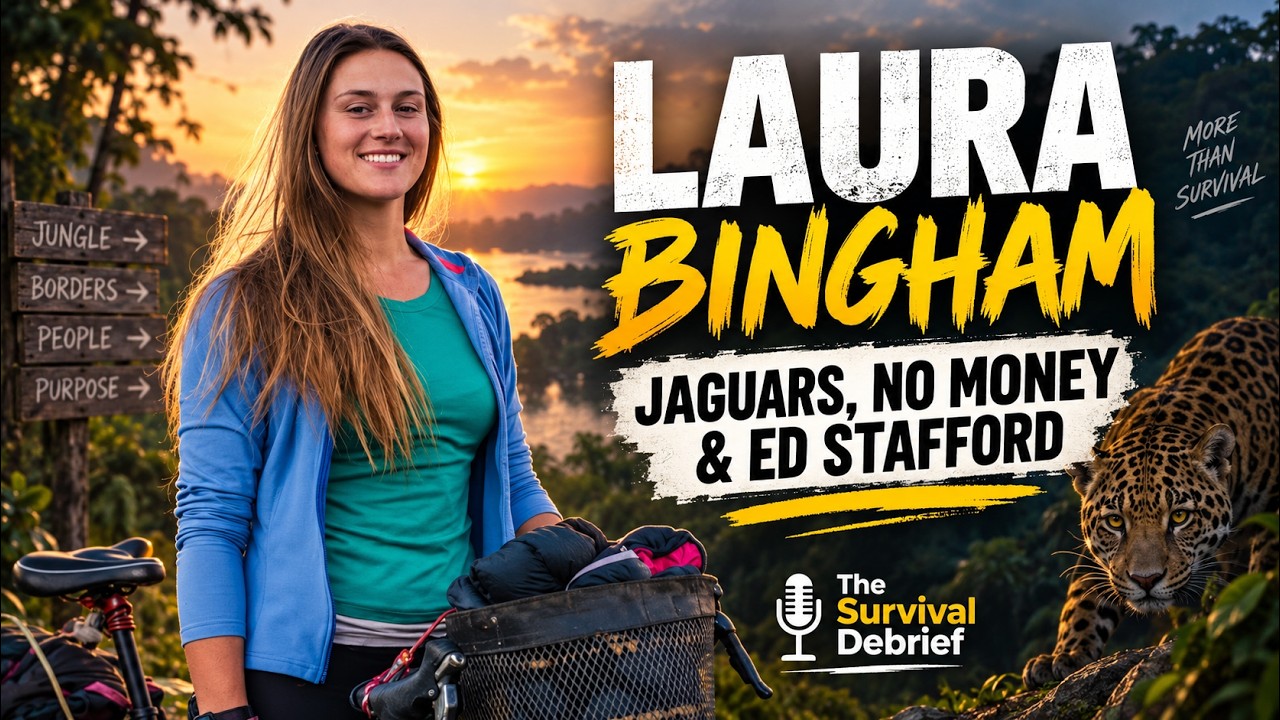
Laura Bingham: Jaguars, No Money and Life with Ed Stafford
What happens when an explorer removes money, comfort and certainty from an expedition?
British explorer Laura Bingham joins me, Steven Kelly, on The Survival Debrief for an honest conversation about jungle danger, a near-death rapid, cycling across South America without money, motherhood, teamwork and life alongside fellow explorer Ed Stafford.
Laura has sailed across the Atlantic, completed a major no-money cycling expedition across South America and led an all-female team through the Guyanese jungle. This episode goes beyond the polished version of those achievements and gets into the fear, judgement, mistakes and human behaviour behind them.
Watch Laura Bingham on The Survival Debrief
Watch the full Laura Bingham interview on YouTube.
Prefer audio? Listen to the episode on Spotify.
Who is Laura Bingham?
Laura Bingham is a British explorer, adventurer, expedition leader and author whose major challenges have placed her in environments where plans, resources and personal limits are repeatedly tested.
Her adventures include sailing across the Atlantic, cycling thousands of kilometres across South America without a conventional travel budget and leading an all-female expedition down the Essequibo River in Guyana.
She also appeared with her husband, explorer Ed Stafford, and their young son in Man Woman Child Wild. That experience created a very different survival challenge because every decision involved not only Laura and Ed, but their child as well.
The impressive list of achievements matters, but it is not the most useful part of Laura's story. What makes her a strong guest is the way she speaks about vulnerability, judgement, dependence on other people and the mental shift from trying to prove individual toughness to recognising the strength of a capable team.
Cycling across South America with no money
One of the central stories in the episode is Laura's journey cycling across South America without money for the normal comforts of food and accommodation.
The phrase no-money expedition can sound like a marketing hook until the practical reality is explained. It meant relying on strangers, searching for food, accepting uncertainty and repeatedly putting herself in situations where she could not simply pay to solve the next problem.
Laura talks about eating food that other people would discard and depending on human kindness to keep moving. That strips adventure back to something far more uncomfortable than distance or physical effort. It becomes a daily test of judgement, humility and the willingness to ask for help.
The expedition also changed how she viewed poverty and privilege. Choosing to travel with very little is not the same as having no choice. Laura could eventually leave the expedition, return home and regain access to normal support. Many of the people she met did not have that escape route.
That distinction is important. The trip showed how quickly a lack of money removes options, but it also revealed generosity from people who often had very little themselves.
What relying on strangers taught Laura
Modern adventure is usually built around controlling risk: equipment lists, route plans, communications, money and backup systems. Laura deliberately removed one of the biggest safety nets.
That forced her to read people, communicate clearly and decide when to trust. Travelling as a young woman added another layer because every offer of help required a judgement about the person, the place and the potential risk.
The strongest lesson was not that everyone is safe. They are not. It was that human connection became part of the expedition system. Progress depended on relationships rather than simply fitness or equipment.
For anyone interested in survival, that is worth remembering. Self-reliance is valuable, but the idea that the strongest person never needs anyone else is fantasy. In most genuine emergencies and expeditions, communication and cooperation matter as much as technical skill.
Jaguars, caiman and danger in Guyana
Laura's Guyana expedition produced some of the most gripping stories in our conversation.
She describes discovering that a jaguar had walked through camp and hearing a caiman close to her hammock. In those moments, a thin shelter is not a proper barrier. You are sleeping inside the animal's environment and have to accept that control is limited.
Wildlife naturally creates dramatic stories, but the river presented the more immediate danger.
Laura recounts being thrown towards a dangerous rapid and experiencing the strange slowing of time that can happen during a serious incident. She genuinely believed she might die.
That is where expedition experience becomes more than a collection of outdoor skills. Fear affects perception, movement and decision-making. The job is not to feel nothing. The job is to keep enough control to make the next useful decision.
It is a principle I recognise from my own survival challenges on Naked and Afraid. Hunger, fatigue and danger reduce your margin for error. When the environment changes quickly, ego and panic both become liabilities.
Leading an all-female jungle expedition
Joining an expedition and leading one are completely different responsibilities.
As a participant, you are responsible for your effort, your decisions and your effect on the team. As a leader, you also carry the consequences of other people's fatigue, confidence, conflict and exposure to risk.
Laura's journey down the Essequibo River required far more than paddling. The team had to operate through remote jungle and river systems, deal with uncertainty and keep functioning when conditions became uncomfortable.
During the episode, Laura explains how her view of strength has changed. Adventure culture often celebrates the lone individual who needs nobody. Experience taught her that strong teamwork is not weakness. It multiplies capability.
That is a serious leadership lesson. The strongest team is rarely a collection of people all trying to prove they are the toughest. It is a group that communicates honestly, recognises when somebody is struggling and uses different strengths without allowing ego to take over.
Motherhood, loss and a different relationship with risk
Laura also speaks openly about motherhood and how having children altered the way she thinks about danger.
Becoming a parent does not automatically remove the desire for adventure, but it changes the consequences. Risk is no longer entirely personal. Decisions affect the people waiting at home and the children who depend on you returning.
Laura and Ed took their young son into the Indonesian jungle for Man Woman Child Wild. Viewers saw a family trying to live in a demanding environment, but the television edit could never show every job, conversation or decision behind the experience.
In the podcast, Laura discusses the practical reality of living in the wild as a family and some of what television did not show her doing. We also get into how parenthood, difficult personal experiences and loss have affected her outlook.
The useful question is not whether parents should stop taking risks. That is too simplistic. The real question is whether the risk has a clear purpose, has been assessed properly and is worth the potential cost.
What is life really like with Ed Stafford?
It would be pointless to interview Laura and avoid the question everybody wants answered: who is the better survivalist, Laura Bingham or Ed Stafford?
Laura gives a brilliant answer when asked who would last longer if they were dropped separately into the jungle with nothing. The exchange is funny, competitive and revealing because it shows the dynamic between two people who both understand expedition pressure.
We also discuss what Laura and Ed are really like together, how their skills differ and the stories viewers did not see during Man Woman Child Wild, including the unforgettable tale involving Ed and their son's praying mantis.
The bigger point is that couples who work in the same world do not need identical strengths. One person may be better at a technical task while the other manages morale, communication or the bigger picture. Survival is not a scoreboard unless the format deliberately makes it one.
Could Laura Bingham take on a survival race?
The episode also raises the possibility of Laura racing Ed in a survival format such as First Man Out.
That would work because the tension is not manufactured. They know each other's strengths, weaknesses and habits. They would also approach the challenge with different temperaments.
Laura has already proved she can tolerate uncertainty, physical hardship and extended expeditions. The more interesting test would be decision speed: when to push, when to conserve energy and when to accept help.
Those are the choices that often determine survival television outcomes. Technical skill matters, but so does energy management, adaptability and the ability to remain useful after the original plan fails.
Laura Bingham's next major expedition
Laura also reveals plans for Walk as One Uganda, a major expedition covering more than 650 kilometres while supporting International Justice Mission.
The project combines distance, community and fundraising rather than treating the expedition as a purely personal achievement. It reflects a consistent theme in Laura's work: adventure can create attention, but that attention should be used for something bigger than the person at the centre of it.
A long walking expedition presents different problems from a river journey or no-money cycle. Repetitive strain, foot care, heat, hydration, logistics and the mental grind of getting up and covering distance again all become decisive.
The goal is ambitious. That is exactly why it deserves attention.
Seven lessons from my conversation with Laura Bingham
- Fear is information, not an instruction. It should sharpen judgement without taking control of it.
- Self-reliance has limits. Capable people still need teams, local knowledge and human kindness.
- Leadership increases responsibility. It is no longer only your own performance that matters.
- Removing money removes options. It exposes how much normal travel depends on buying a solution.
- Parenthood changes the risk calculation. The consequences now extend beyond the individual.
- Television never shows everything. An edit captures the story, not every job or decision behind it.
- A difficult expedition needs a purpose. Hardship alone is not automatically meaningful.
Listen to Laura Bingham on Spotify
You can listen to the complete Laura Bingham episode of The Survival Debrief on Spotify.
Play Laura Bingham on The Survival Debrief on Spotify.
Watch the full podcast on YouTube
Watch Laura Bingham: Surviving Jaguars, Cycling With No Money and Life With Ed Stafford.
If you enjoy honest conversations with explorers, survivalists and people who have genuinely tested themselves, subscribe to the channel and explore more episodes on The Survival Debrief podcast page.
Frequently asked questions
Who is Laura Bingham?
Laura Bingham is a British explorer, adventurer, expedition leader and author. Her expeditions include an Atlantic sailing crossing, cycling across South America without money and leading an all-female journey down the Essequibo River in Guyana.
Is Laura Bingham married to Ed Stafford?
Yes. Laura is married to British explorer and television survivalist Ed Stafford. They have also appeared together with their son in Man Woman Child Wild.
What does Laura discuss on The Survival Debrief?
Laura discusses cycling across South America with no money, jungle wildlife, a near-death river incident, expedition leadership, motherhood, survival television, life with Ed Stafford and her planned Uganda expedition.
Where can I watch the Laura Bingham podcast?
The full episode is embedded near the top of this article and is available on Steven Kelly's YouTube channel. The audio edition is available on Spotify.
Who hosts The Survival Debrief?
The Survival Debrief is hosted by Steven Kelly, also known as Survival Ste, a British TV survivalist, former 29 Commando Regiment soldier and founder of South West Survival.
About Steven Kelly and The Survival Debrief
Steven Kelly, also known as Survival Ste, is a British TV survivalist, former 29 Commando Regiment soldier, professional survival instructor and founder of South West Survival.
His television credits include Discovery's Naked and Afraid and Naked and Afraid: Apocalypse, Naked, Alone and Racing to Get Home and the BBC's Bear Grylls: Wild Reckoning.
The Survival Debrief features long-form conversations with survivalists, explorers, adventurers and outdoor experts about what really happens when plans fail and pressure takes over.
For television, podcast, speaking and media enquiries, visit the Speaking and Media Enquiries page.
7 Skills That Kept Me Alive on Naked and Afraid
Get the free guide, plus new journal posts and podcast episodes when they drop. Written by me, not an algorithm.
No spam. Unsubscribe any time.