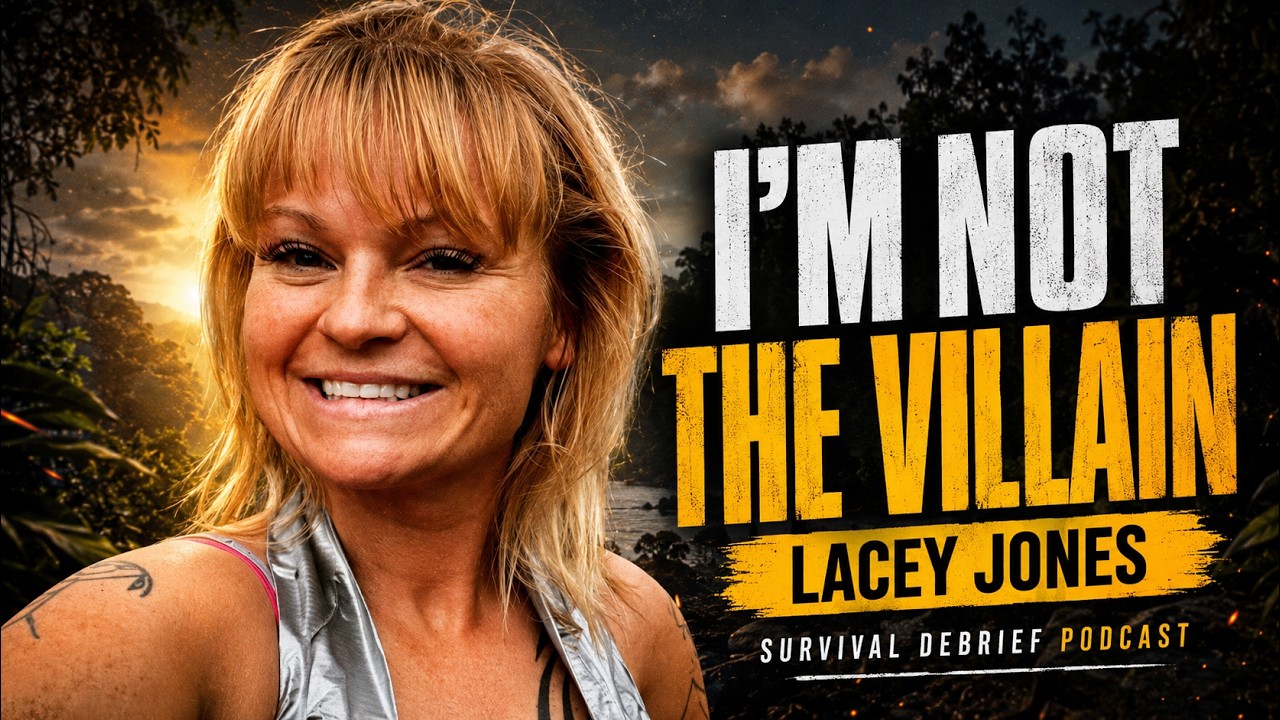
Lacey Jones Interview: Naked and Afraid, Last One Standing and Why She’d Return
Naked and Afraid survivalist Lacey Jones joins Steven Kelly on The Survival Debrief Podcast for one of the most direct conversations the show has had so far.
Lacey talks about her military background, growing up in rural Maine, the reality of repeated survival challenges, what happened to her on Last One Standing, difficult partnerships, the "villain" label and whether she would ever answer the call for another Naked and Afraid challenge.
There is very little filtering in this episode. That is exactly what makes it worth watching.
Steven and Lacey also compare the crossover between military experience and survival television, and why technical skill alone is not enough when hunger, exhaustion, personality and pressure all start working against you.
Steven Kelly, also known as Survival Ste, is a British TV survivalist, former 29 Commando Regiment soldier, survival instructor, founder of South West Survival and host of The Survival Debrief Podcast.
Watch the full Lacey Jones interview
Watch Lacey Jones on The Survival Debrief Podcast on YouTube.
Listen to Lacey Jones on Spotify
Listen to the full Lacey Jones interview on Spotify.
You can also explore more survival interviews through the official Survival Debrief Podcast hub.
Who is Lacey Jones?
Lacey describes herself as someone who did not have a conventional start in life.
She grew up near Liberty, Maine, on an island without running water or electricity. She later went to college, joined the military and served overseas. During the interview she explains that she remains connected to the National Guard in an engineering officer role and also works professionally as a safety engineer.
That combination creates one of the contradictions that makes her such a distinctive television personality. On screen she has become known for being outspoken, impulsive and willing to say exactly what she thinks. Away from television, her professional life is built around engineering, safety and military responsibility.
Lacey jokes that these are two different versions of the same person.
How did Lacey Jones get on Naked and Afraid?
Steven asks how Lacey managed repeated survival television appearances while also serving in the military.
Lacey credits supportive commanders and the flexibility she had as an officer. She also explains that her civilian career has sometimes taken second place when a new survival opportunity appeared.
Her reasoning is simple. A salary matters, but unusual life experiences are difficult to replace.
She talks about travelling to places most people will never see, taking part in cultural ceremonies and being put into environments that create memories no normal job can reproduce.
That is a theme Steven immediately understands. His own Naked and Afraid challenges took him to Colombia and South Africa, and both describe the strange pull that extreme survival television can have after the challenge is finished.
What happened to Lacey Jones on Last One Standing?
One of the most revealing parts of the conversation is Lacey's account of her early exit from Naked and Afraid: Last One Standing.
She explains that she rushed towards the log closest to the exit during a challenge without properly assessing the terrain. The position she chose was deep mud, while other competitors were able to work from firmer ground.
The mistake became particularly painful because of her military engineering background. Lacey says grapple-hook work is something she understands professionally, yet in the moment she made a poor terrain decision and paid for it.
She pushed herself hard enough to become physically sick before the challenge ended.
It is a useful example of something survival television exposes very quickly: knowledge and performance are not the same thing.
You can know how to complete a task and still make the wrong decision when the clock, terrain, fatigue and competition are all adding pressure.
Does Lacey Jones think she was unfairly portrayed as a villain?
Steven asks the question directly: does Lacey believe television unfairly portrayed her as a villain?
Her answer is more interesting than blaming the edit.
No.
Lacey says the things viewers heard came out of her mouth and she owns them. She accepts that she has little filter, can be highly opinionated and often says things other people might think but choose not to say publicly.
She also explains that after watching her first programme and realising how she was likely to be perceived, she decided to lean into it rather than pretend to be somebody else.
That distinction matters. Reality television can shape a story through editing, but Lacey is not trying to rewrite her own behaviour after the fact.
Her position is essentially: this is who I am, and I would rather be honest about it.
Why Ecuador was one of Lacey's hardest challenges
When Steven asks which challenge was the hardest, Lacey points towards Ecuador.
The constant rain, lack of sunshine and rainforest conditions were part of the problem, but the social side of the challenge mattered just as much.
Lacey describes herself as someone who uses the diary camera as an actual diary. If she thinks something, she is likely to say it. She is uncomfortable with contestants who try to manage how they will be portrayed or make informal agreements about what they will or will not say about each other.
For her, that damages the reason she is there.
She wants to survive, have the experience and let the television show what actually happened rather than build a polished reality-TV persona.
Why surviving alone was harder than Lacey expected
Lacey originally believed that being alone might suit her better than working with a difficult partner.
She found the opposite.
During the interview she describes surviving without even having a pot, living around large numbers of elephants and dealing with the mental strain of isolation.
She is unusually open about the fact that the mental side can be one of her weaker areas.
Family was a major part of that pressure. Lacey explains that repeated challenges meant missing important moments while her children were young, including first days at school and other milestones.
Now that her children are older, she believes she would approach another survival challenge differently.
That is an important point because viewers often judge a survivalist only on visible technical performance. What is happening at home can be just as powerful as what is happening in the shelter.
Who does Lacey Jones rate as a survival partner?
The podcast gets into the people Lacey has worked with and what she actually values in a partner.
She describes Matt Wright as an exceptionally talented survivalist, but also points out one problem with having somebody that capable in a team: other people can become complacent because one person is doing so much of the work.
Lacey says she would rather have a partnership where both people push each other and build the experience together.
She speaks particularly warmly about Clarence Gilmer and Giovanna, describing the calming effect they had on her personality and the value of working with people who could bring balance to a group.
She also says she would be open to working with Amber again now that more time has passed and both would be meeting each other at a different stage of life.
The bigger lesson is that the most technically skilled person is not automatically the best partner. Temperament, communication and how people divide effort matter enormously.
Would Lacey Jones return to Naked and Afraid?
This is where the interview becomes especially interesting for fans wondering whether Lacey's survival-TV career is finished.
Steven asks whether she would go back if she received another call.
Lacey makes it clear that she is still open to another challenge. She jokes about how persuasive the production team can be and says viewers have not seen the last of her.
But there is also a more personal reason she would return.
Lacey says she wants what she has seen other contestants build: a genuine partner bond that survives after the programme ends.
She has experienced finishing a challenge, but she wants the experience of completing one alongside a partner who becomes a long-term friend.
For somebody whose television history has included difficult partnerships, that would create a very different story.
Lacey Jones' advice for people who want to get outdoors
The final survival question is deliberately simple. Steven asks Lacey what advice she would give somebody who has never really spent time outdoors.
Her answer is exactly what you would expect from her: stop overcomplicating it and go outside.
She argues that people often treat ordinary nature, insects and dirt as more threatening than they really are. Her wider message is to become more comfortable outside, pay attention to the environment around you and build familiarity through experience rather than fear.
That does not require an extreme survival challenge.
Start with a local walk. Learn basic outdoor safety. Understand the plants and wildlife where you live from reliable sources. Build confidence gradually.
Real outdoor capability starts by actually spending time outdoors.
Five lessons from the Lacey Jones interview
1. Owning mistakes is stronger than rewriting them
Lacey does not blame every bad moment on editing. She admits when she made the wrong call, including her terrain mistake on Last One Standing.
2. Technical skill does not remove pressure
An experienced engineer can still make a poor decision under competition pressure. A military background can help, but it does not make anybody immune to fatigue, haste or emotion.
3. Survival partnerships are about more than skill
The best teammate may be the person who improves the whole group's performance, not the person who can personally do the most.
4. Family changes the survival equation
Isolation is harder when somebody is thinking about young children and milestones being missed at home.
5. Authenticity has a cost
Lacey's willingness to say exactly what she thinks has made her memorable, but it has also created conflict. Being authentic does not remove the consequences of what you say.
Watch or listen to the full episode
Subscribe for more conversations with survivalists, adventurers, military veterans and people who have been tested in extreme environments.
Related survival interviews and articles
- Ky Furneaux Interview: Naked and Afraid, Ed Stafford and Survival Mindset
- Is Naked and Afraid Real? The Truth From Someone Who Survived 56 Days
- British Naked and Afraid Survivalists: The UK Contestants
- Steven Kelly on Naked and Afraid
Frequently asked questions
Who is Lacey Jones?
Lacey Jones is a military veteran, engineering professional and recurring survival television personality known for appearances in the Naked and Afraid franchise.
What does Lacey Jones discuss on The Survival Debrief Podcast?
The interview covers her military background, repeated survival challenges, Last One Standing, difficult partnerships, the villain label, surviving alone, family, other survivalists and whether she would return for another challenge.
Does Lacey Jones think Naked and Afraid unfairly portrayed her as a villain?
No. During the interview Lacey says she owns the things she said on television. She accepts that she is outspoken and has very little filter, while also explaining the background that shaped her personality.
Would Lacey Jones do Naked and Afraid again?
She leaves the door open. Lacey says viewers have not seen the last of her and explains that one reason she would return is the chance to finally complete a challenge with a genuine long-term partner.
Where can I watch the Lacey Jones interview?
The full interview is embedded near the top of this article and is available on Steven Kelly's YouTube channel.
Where can I listen to the Lacey Jones interview?
The complete audio episode is available on Spotify through The Survival Debrief Podcast.
Who hosts The Survival Debrief Podcast?
The podcast is hosted by Steven Kelly, also known as Survival Ste, a British TV survivalist, former 29 Commando Regiment soldier, survival instructor and founder of South West Survival.
About The Survival Debrief Podcast
The Survival Debrief Podcast gives survivalists, adventurers, military veterans and television personalities room to explain the stories that cannot fit into a television edit.
For more episodes, visit the official Survival Debrief Podcast page.
For speaking, television and media enquiries, visit Steven Kelly's speaking and media enquiries page.
7 Skills That Kept Me Alive on Naked and Afraid
Get the free guide, plus new journal posts and podcast episodes when they drop. Written by me, not an algorithm.
No spam. Unsubscribe any time.