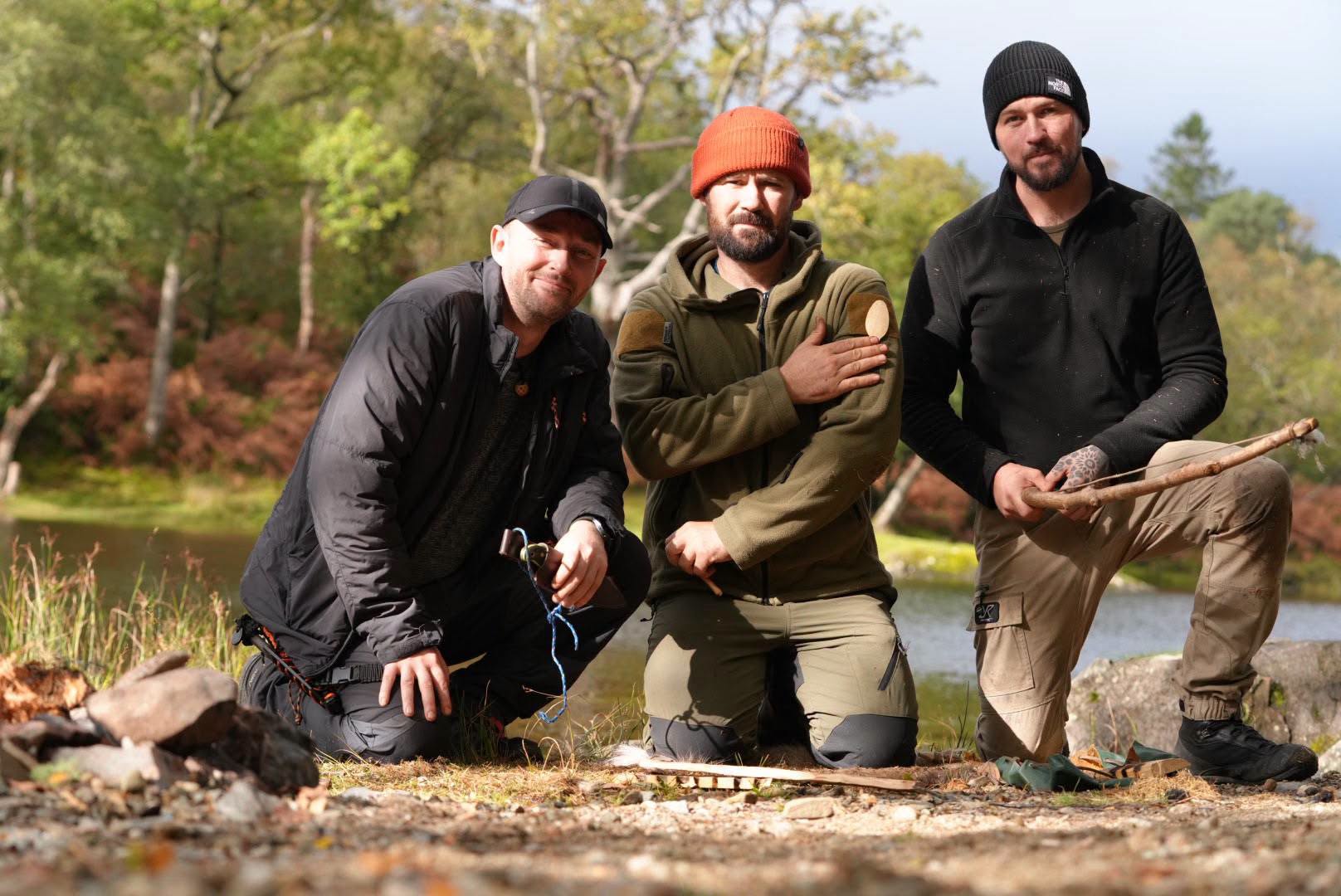
Highland Reckoning Episode 4: Shelter Collapse, Deceit & the Haunted House
Episode 4 of Highland Reckoning changes the whole feel of the challenge. Sam's shelter collapses around him, trust gets tested before we leave camp, I start turning the deer hides into usable pelts, and the three of us move into an abandoned Highland property that gets more unsettling the longer we're inside it.
This was the point where Highland Reckoning stopped feeling like we had settled into a survival routine. We'd built camp, processed food and started working well as a team. Then one broken ridge pole, one letter and one very questionable interpretation of the instructions changed everything.
Watch Highland Reckoning Episode 4
Watch Highland Reckoning Episode 4 on YouTube
Sam's shelter comes down on him
The day starts badly for Sam. He had been lying in his shelter when the ridge pole began creaking. The creaking turned into cracking, and before he could get completely clear the structure came down and trapped his legs underneath it.
Jamie and I got over to help lift the weight off him. Thankfully he wasn't seriously hurt, but it was a proper reminder that a shelter doesn't become safe just because it has survived the previous night.
Sam had demonstrated the shelter build earlier in the challenge and admitted afterwards that he should have checked the ridge pole more carefully. Natural materials change. Timber can split. Loads shift. A structure you trusted yesterday still needs checking today.
We gave him plenty of grief afterwards, including a few jokes about flat-pack survival shelters, but the collapse had another consequence. It opened the door to the next challenge.
The letter gives us a choice. Sam tells us otherwise.
A new instruction arrived for the team. Because Sam's shelter had collapsed, we were given two options.
We could stay where we were, rebuild and keep the camp we'd spent days establishing. Or we could leave it behind and move through a series of checkpoints to an abandoned Highland property described as having a "spirited past".
The letter also made one thing very clear: we had a choice, and we were not supposed to destroy the instructions.
That is not quite the version Jamie and I were given.
Sam came back and told us there was basically no choice and that we had to move. He also claimed the letter said it had to be destroyed. By the time I started questioning the route and the coordinates, the evidence had disappeared.
It was funny in the moment, but it changed the dynamic. In a real remote environment, navigation information and clear communication matter. If one person has the route, the grid, the timings or the contingency plan, everyone else is relying on that person to pass it on accurately.
One last meal before leaving camp
Before moving, we cooked some of the deer meat and packed the rest. The smoking we'd done earlier in the challenge had made a big difference. The meat was drier, easier to divide between our packs and much easier to transport than fresh meat that was still wet and leaking.
We had built a decent camp and reached the point where we were starting to thrive. That made leaving harder. Survival is often about investing energy into improving your position, so deliberately walking away from shelter, fire and known resources feels wrong unless there is a good reason.
But Highland Reckoning was designed to keep pushing us out of that comfortable rhythm.
Turning the deer hide into something useful
Before I could properly move on, I wanted to do more work on the hides.
Taking the skin off the animal was only the first step. There was still flesh and fatty tissue attached to the back, and the hide needed to be prepared so we could transport it without it turning into a wet, heavy mess.
I used ash from the fire to help dry the remaining tissue. As the surface dried, the membrane and fatty material became easier to scrape and peel away in large sections.
The goal at this stage wasn't to complete a perfect finished hide at camp. We were moving. I needed to reduce the moisture, clean it up enough to carry, roll it, get it to the next location and continue the process later.
That is the sort of job I enjoy because it shows what "use everything" actually means. The deer had already provided meat. The hide was another resource. Instead of leaving it behind, we were trying to turn it into a pelt that could eventually be used as insulation, bedding or material.
The walk to the abandoned house
Jamie and Sam moved ahead while I finished the hide and packed the kit. I ended up following behind carrying our food and the hides, eating a few blueberries on the way and trying to make sure I was still heading in the right direction.
The woodland already felt different. The closer I got to the property, the more isolated it felt.
Then the building came into view.
It looked exactly like the sort of place you don't want to arrive at knowing you're expected to sleep there for the next 24 hours. I remember looking at it and thinking it was properly eerie. I wasn't pretending to be comfortable with it. I wasn't.
Noises inside the house
Once we were together, things got stranger.
There were noises from upstairs. Doors were moving. The building was full of holes, unstable areas and places where you had to think carefully about where you put your feet.
At one point we all started moving upstairs to investigate. There was plenty of bravado, but none of us were particularly keen on being the person at the front.
The temperature seemed to change in parts of the building and the atmosphere started getting to us. We were showing each other goosebumps, arguing about who was going first and reacting to sounds and movement around the rooms.
Whether you believe in ghosts or not, an abandoned building in a remote area at night is very good at making your brain work overtime.
The real danger wasn't paranormal
The funny part is that while we were worrying about noises and shadows, the real hazards were much more obvious.
The floors had holes in them. Parts of the structure looked unstable. There was old ammunition in the building that we deliberately avoided handling. We also found a significant amount of guano and decided we needed to move away from that area.
That is worth remembering. When people get frightened, attention can lock onto the dramatic threat. Good situational awareness means continuing to notice the ordinary hazards that can actually injure you.
Scottish folklore makes everything worse
Then, because apparently the house wasn't creepy enough, we started looking up Scottish folklore.
We ended up reading about creatures and stories including the Nuckelavee and the Baobhan Sith. We weren't presenting any of it as proof that something paranormal was in the building. We were three tired blokes in an eerie Highland property reading frightening folklore and doing a very good job of making ourselves more nervous.
It definitely did not improve the atmosphere.
Trust becomes part of the survival challenge
What makes Episode 4 interesting for me isn't just the haunted-house element. It is the way trust becomes another resource.
Up to this point most of our problems had been practical: shelter, fire, food, water, preserving meat and dealing with the environment. In this episode, the challenge shifts towards information and group dynamics.
Do you trust the person who has read the instructions? Do you trust that the route is right? Do you challenge something that doesn't make sense? How much does tiredness affect the way you respond?
In a real expedition, clear information is as important as equipment. A good team needs people who can challenge decisions without destroying the ability to work together afterwards.
What Episode 4 taught me
For me, Episode 4 is about adaptability.
Sam's shelter went from home to wreckage in seconds. The established camp stopped being our base. The deer hide went from waste material to something we could potentially preserve and use. Then our sleeping area changed from woodland shelters to an abandoned building full of unfamiliar risks.
None of those changes were part of the comfortable plan.
That is why survival skills are useful beyond survival television. The individual techniques matter, but the bigger skill is being able to reassess, make a new plan and keep moving when the conditions change.
Catch up with Highland Reckoning
If you haven't watched the earlier episode, read Highland Reckoning Episode 3: Fire, Foraging & Fear.
For every released episode, trailer and series update, visit the official Highland Reckoning series page.
You can also watch the Highland Reckoning playlist on YouTube.
Learn practical survival skills
For hands-on survival and bushcraft training in Devon, visit South West Survival.
The Survival Debrief Podcast
For longer conversations with survivalists, adventurers and outdoor experts, listen to The Survival Debrief Podcast with Steven Kelly.
About Steven Kelly
Steven Kelly, also known as Survival Ste, is a British TV survivalist, former 29 Commando Regiment Royal Artillery soldier, survival instructor and host of The Survival Debrief Podcast. His television credits include Naked and Afraid and Naked and Afraid: Apocalypse. Highland Reckoning is his independently produced Scottish survival series with Jamie Frizzell and Sam Mouzer.
7 Skills That Kept Me Alive on Naked and Afraid
Get the free guide, plus new journal posts and podcast episodes when they drop. Written by me, not an algorithm.
No spam. Unsubscribe any time.