Fake Dating Profiles and Romance Scams: How Scammers Use Stolen Photos to Manipulate Victims
Most people still think survival means fire, shelter, water and food.
That is only part of it.
In the modern world, survival also means being able to spot manipulation before it gets hold of you. Sometimes the threat is not bad weather, hunger or cold. Sometimes it is a fake profile on a dating app, a message from someone pretending to care, or a scammer using stolen photos to build trust.
This is where catfishing, romance fraud and stolen identity online all overlap.
This has happened to me personally.
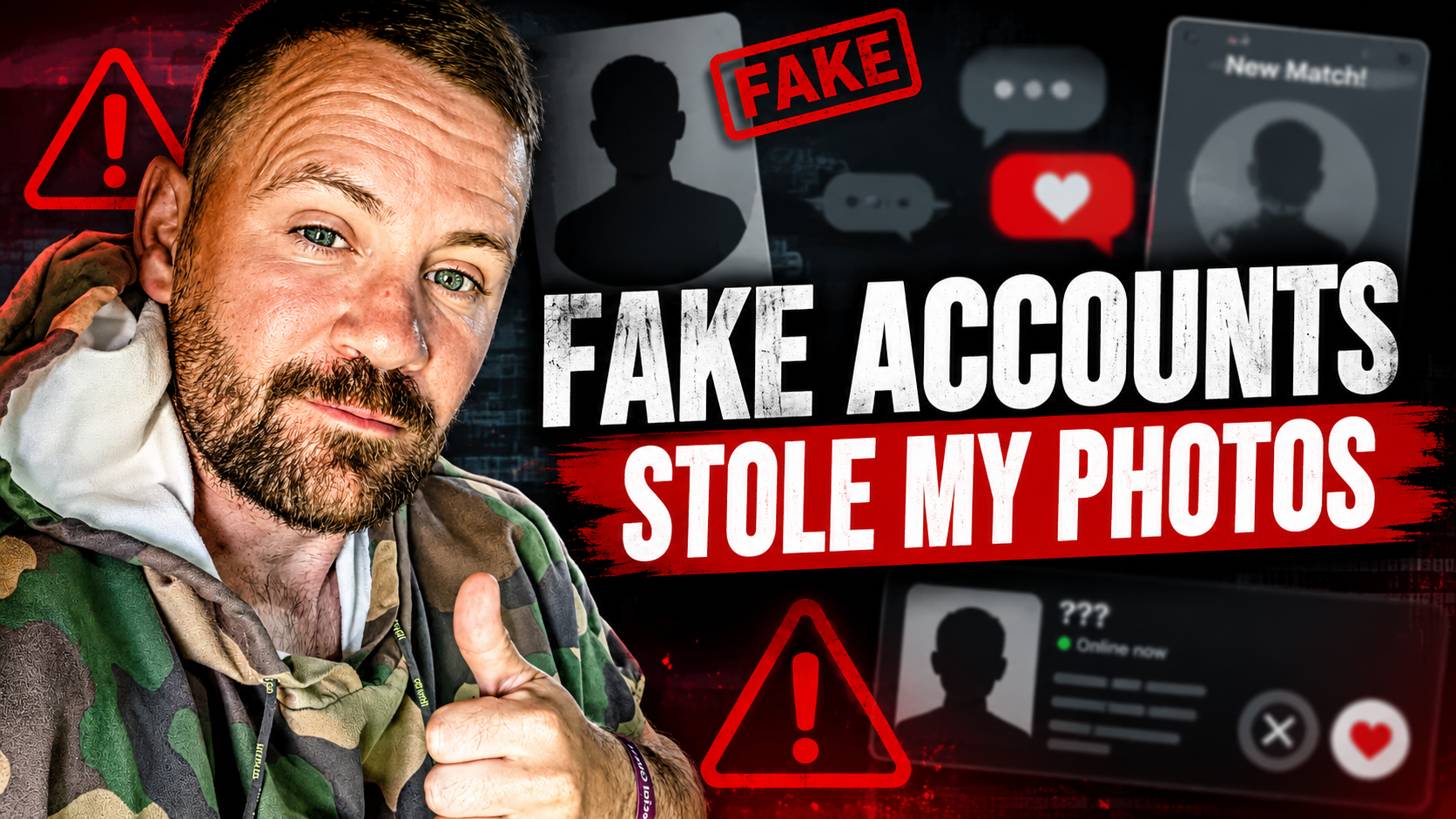
My photographs have been taken and used without my consent on dating platforms, including Tinder and Grindr, as well as on fake social media accounts. These profiles were not me. They were scammers using my image, my public profile and my credibility to make fake accounts look more believable.
That is the part people need to understand: fake profiles are not always badly made or obvious. Scammers often steal real photos from real people because it gives the account instant trust.
This is not about embarrassment. It is about consent, identity theft and manipulation.
This is not just an online nuisance
Romance fraud is a serious problem in the UK.
The Financial Conduct Authority reported that more than £106 million was lost to romance fraud in the UK during the 2024/25 financial year, with victims losing an estimated average of £11,222 each. The FCA also reported that cases rose by 9% last year, and that 85% of cases started online, particularly through social media and dating websites.
Source: Financial Conduct Authority — Banks need to help “break the spell” of romance scams
https://www.fca.org.uk/news/press-releases/banks-need-to-help-break-spell-romance-scams
That is why I keep speaking about this issue.
I previously spoke to Tony Snell on BBC Radio Merseyside about survival, romance scams, stolen identity and decision-making under pressure.
Read my BBC Radio Merseyside interview on romance scams and stolen identity:
https://www.stevenkelly.uk/journal/bbc-radio-merseyside-interview-steven-kelly-on-survival-romance-scams-and-stolen-identity
Fake accounts are reconnaissance
In the military and in survival training, you learn that danger does not always announce itself loudly.
A lot of threats start quietly.
Scammers work in the same way. They observe, test, probe and build a picture of the person they are targeting. They look for loneliness, grief, recent divorce, confidence issues, money worries, kindness, trust and emotional vulnerability.
Then they build a story around it.
That is why fake accounts are not random. They are a form of reconnaissance.
They are looking for a way in.
Why scammers steal real photos
A fake profile with poor images is easy to question.
A fake profile using real photos from a real person is much harder to spot.
That is why scammers use images from soldiers, veterans, fitness accounts, survival instructors, public figures, doctors, contractors and people with strong-looking profiles. The image gives the account a ready-made identity.
It creates instant trust.
If the person in the photo looks confident, capable, professional or adventurous, the scammer can use that image to sell a story.
That might be:
- “I’m deployed overseas.”
- “I work away a lot.”
- “I’m on an oil rig.”
- “I’m doing private security.”
- “I’m widowed.”
- “I can’t video call because of my job.”
- “I need help just this once.”
The photo is bait.
The story is the hook.
The warning signs of a fake dating profile or romance scam
Not every fake account looks fake at first.
Here are the warning signs I would watch for.
1. They move emotionally fast
If someone you have just met online is already talking about love, commitment, destiny or a future together, slow down.
Scammers often create emotional intensity early because it shuts down logical thinking.
They do not want you calm.
They want you attached.
2. They avoid proper verification
They may avoid video calls, give excuses, claim poor signal, say their camera is broken, or pretend they cannot show their face because of work.
One excuse can be genuine.
Constant excuses are a pattern.
3. Their story explains why you cannot meet
Common scammer stories often involve distance, travel or work that keeps them unavailable.
Military deployment, overseas contracting, oil rigs, remote work and charity work are all commonly used because they explain why the person cannot meet in real life.
4. They try to move you off the platform
If someone quickly wants to move from a dating app to WhatsApp, Telegram or another private messaging platform, be careful.
That often removes the protection and reporting tools built into the original platform.
Report Fraud advises people to be cautious if someone they have only met online asks for money, vouchers, cryptocurrency or investment money. It also advises people to check profile pictures using tools such as Google image search or TinEye.
Source: Report Fraud — Romance fraud guidance
https://www.reportfraud.police.uk/romance-fraud/
5. They create secrecy
A major warning sign is when someone says:
“Don’t tell your family.”
“They won’t understand us.”
“This is private between you and me.”
“Your friends are jealous.”
That is not romance.
That is isolation.
6. They create urgency
Scammers love pressure.
They might say they need money quickly for travel, medical bills, legal issues, work problems, customs fees, a broken phone, a blocked bank account or an emergency involving a child.
Urgency is designed to make you act before you think.
7. They ask for money
The money request is not the start of the scam.
It is the extraction phase.
By the time money is requested, the grooming has usually already happened.
Never send money, gift cards, cryptocurrency, bank transfers or investment payments to someone you have only met online.
Why good people fall for it
People like to think only gullible people get scammed.
That is rubbish.
Scammers target emotion, not intelligence.
Loneliness, grief, kindness, hope and trust can all be exploited. Good people are often vulnerable because they want to believe the best in others.
That is not weakness.
But it becomes dangerous when emotion overrides verification.
In survival, one bad assumption can put you in trouble fast.
Online, the same rule applies.
My simple rule: trust slowly, verify early
You do not need to become paranoid.
You do need to become harder to manipulate.
Use this simple approach:
- Reverse image search their photos.
- Ask for a live video call.
- Check whether their story changes.
- Do not send money.
- Do not share private images.
- Do not give out banking details.
- Speak to someone you trust before making decisions.
- Report suspicious profiles to the platform.
- Contact your bank immediately if money has been sent.
- Report fraud through the official UK reporting routes.
If someone is genuine, reasonable verification will not scare them off.
If verification makes them angry, defensive or emotionally manipulative, that tells you something.
What to do if your photos are being used
If your own images are being stolen, act quickly.
Take screenshots. Save profile links. Report the account to the platform. Warn your audience if you have a public profile. Do not engage directly with the scammer unless there is a clear reason to do so.
If money is involved, report it properly.
If someone contacts you saying they have been speaking to “you” on another account, take it seriously. They may already be emotionally or financially invested in the fake relationship.
Be clear. Be firm. Be kind.
But do not get dragged into the scammer’s chaos.
My official accounts
If you are contacted by someone claiming to be me, check carefully.
My official channels are listed through my website:
https://www.stevenkelly.uk/contact
I will never ask strangers online for money, gift cards, cryptocurrency, travel funds, emergency payments or investment help.
If an account using my photos asks for money, it is not me.
Report it.
What to do if you think you are being targeted
Stop sending messages.
Do not send money.
Do not send more personal information.
Take screenshots.
Speak to someone you trust.
Report the account.
Contact your bank if you have sent money.
If you are in England, Wales or Northern Ireland, you can report fraud through Report Fraud. If you are in Scotland, report it to Police Scotland by calling 101.
Report Fraud romance fraud guidance:
https://www.reportfraud.police.uk/romance-fraud/
The worst thing you can do is keep it secret because you feel embarrassed. Shame is one of the scammer’s best weapons.
Break that control early.
Survival is about decision-making
People think survival is about toughness.
It is not.
Survival is about making clear decisions under pressure.
That applies in the jungle, in the mountains, in extreme weather and online.
A fake dating profile may not look like a traditional survival threat, but the principles are the same:
Slow down. Read the signs. Verify the situation. Do not ignore your instincts.
If something feels wrong, it probably deserves checking.
Media enquiries
Steven Kelly is available for media comment on romance scams, stolen identity, online manipulation, survival mindset and decision-making under pressure.
For interviews, expert comment or broadcast enquiries, visit:
https://www.stevenkelly.uk/contact
Final thought
Fake accounts are not harmless.
They damage reputations, manipulate victims, steal money and exploit trust.
My own pictures have been used without my consent on dating sites and social media. That is why I talk about this. Not because it is comfortable, but because people need to understand how easily trust can be manufactured online.
Survival is not just about staying alive outdoors.
It is about staying switched on wherever the threat appears.
Related reading
Read my BBC Radio Merseyside interview on romance scams and stolen identity:
https://www.stevenkelly.uk/journal/bbc-radio-merseyside-interview-steven-kelly-on-survival-romance-scams-and-stolen-identity
Listen to The Survival Debrief Podcast:
https://www.stevenkelly.uk/podcast
Apple Podcasts:
https://podcasts.apple.com/us/podcast/the-survival-debrief-podcast-with-steven-kelly/id1844233698
Follow Steven Kelly
Facebook: https://www.facebook.com/stevenkelly29
TikTok: https://www.tiktok.com/@survival_ste
X: https://x.com/survival_ste
Subscribe
For more survival mindset, real-world safety advice, TV survival insights and behind-the-scenes updates, subscribe to the Steven Kelly newsletter.
Frequently Asked Questions
How can you tell if a dating profile is fake?
Look for inconsistent stories, refusal to video call, overly intense emotional messages, excuses about being overseas, and requests to move quickly onto WhatsApp or Telegram. The biggest warning sign is any request for money, cryptocurrency, gift cards or financial help.
Why do scammers use stolen photos?
Scammers use stolen photos because real images make fake profiles look believable. A strong-looking public image can help them build trust quickly with victims.
What should I do if someone is using my photos on a dating site?
Take screenshots, copy the profile link, report the account to the platform and warn your audience if you have a public profile. If fraud or money is involved, report it through the correct official channels.
Should I send money to someone I met online?
No. If you have only met someone online, do not send money, gift cards, cryptocurrency, bank transfers or investment payments. A sad or urgent story does not make it safe.
Can romance scams happen on social media?
Yes. Romance scams can start on dating apps, Facebook, Instagram, TikTok, WhatsApp, Telegram and other platforms. The platform does not matter. The manipulation pattern does.
What should I do if someone online says they are Steven Kelly and asks for money?
Do not send money. Check the official links on https://www.stevenkelly.uk/contact and report the fake account to the platform. Steven Kelly will never ask strangers online for money, gift cards, cryptocurrency, travel funds, emergency payments or investment help.
The FCA figures above are from its 2025 press release, which states romance fraud cost UK victims £106m in 2024/25, average losses were estimated at £11,222, cases rose by 9%, and 85% started online. Report Fraud backs the key safety advice: never send money to someone you have only met online, report requests for money to the dating service, check images online, and talk to friends or family if something feels wrong.
7 Skills That Kept Me Alive on Naked and Afraid
Get the free guide, plus new journal posts and podcast episodes when they drop. Written by me, not an algorithm.
No spam. Unsubscribe any time.