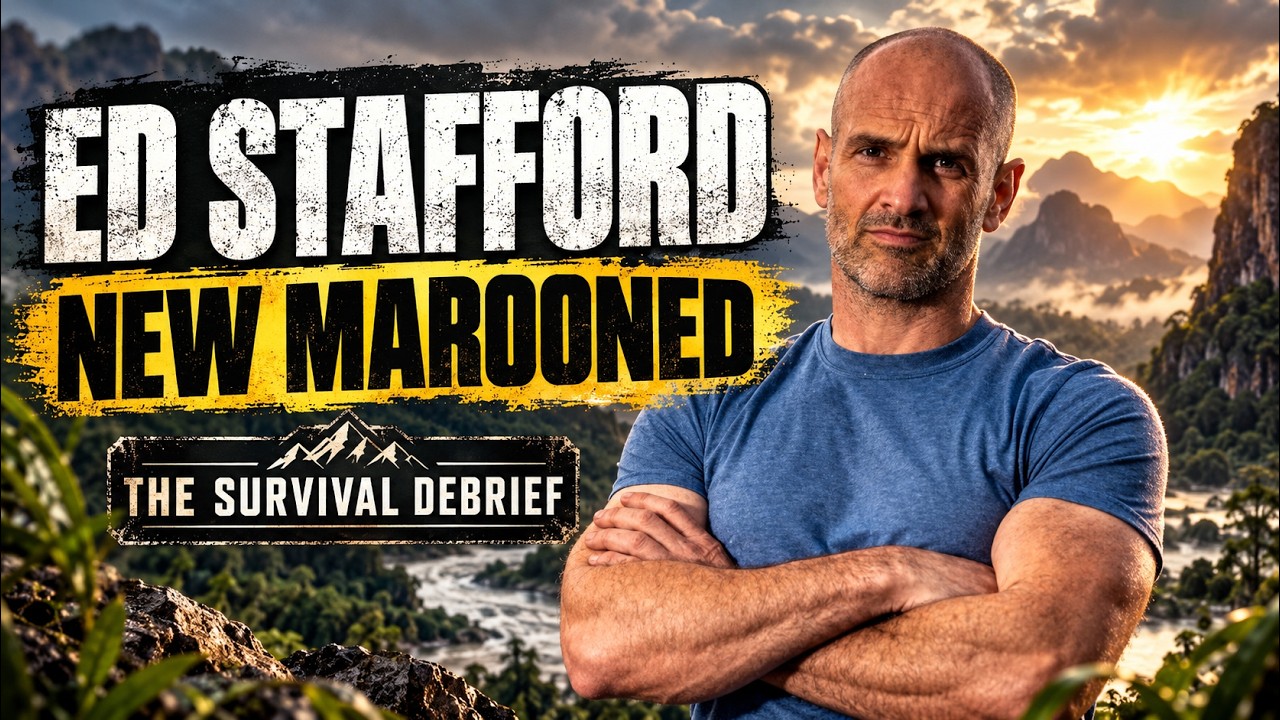
Ed Stafford: The Amazon, 60 Days Alone & Why He Won’t Do Naked and Afraid
Ed Stafford joins me on The Survival Debrief for one of the most open conversations I have recorded about survival, mindset, identity and what extreme expeditions really do to you.
Ed is best known for becoming the first person to walk the entire length of the Amazon River, a journey that took 860 days. In this episode, the conversation goes well beyond the headline achievements. We talk about the military, isolation, self-filming survival television, First Man Out, Naked and Afraid, Antarctica and what happens when the armour starts to come off.
Watch the full Ed Stafford podcast
Watch the full Ed Stafford episode on YouTube
Listen on Spotify
Listen to the full episode on Spotify
Follow @survival_ste on Instagram
Ed Stafford on walking the Amazon for 860 days
One of the first things I wanted to know was whether the man who started the Amazon expedition would recognise the man Ed is today.
His answer set the tone for the whole conversation. Ed explained that the expedition began during a difficult period in his life. He described wanting to disappear from society and escape some of the things he was struggling with at the time.
The Amazon became far more than a physical challenge. It was the beginning of a major change in how he understood himself.
Ed also talked about the danger of moving through the Peruvian red zone, including being held at gunpoint by drug traffickers and having to manage tension with communities that had their own history of violence and trauma.
What stood out to me was his approach to fear. He and his walking partner developed a simple phrase: “we die, we die.” It was not about being reckless. It was about refusing to waste energy worrying about every possible outcome.
The question that kept him moving
During some of the darkest months of the expedition, Ed said one question mattered:
Have you moved forward today?
If the answer was yes, that was enough.
That is one of the strongest lessons from the episode. Big challenges become unmanageable when you constantly think about the finish line. Sometimes the only useful question is whether you moved forward today.
How the British Army shaped Ed Stafford
Ed served as a captain in the British Army, so naturally we talked about how military experience carried over into expedition life.
He explained that the Army had already shown him levels of physical discomfort beyond what many people experience in ordinary life. That created a bank of memories he could draw on when things became difficult.
That connected strongly with my own experience after serving with 29 Commando Regiment Royal Artillery and later taking on Naked and Afraid.
Military experience does not make someone invincible, but it can change the reference point for what hard actually feels like.
The reality of self-filming survival television
One of my favourite parts of the conversation was Ed explaining what self-filming actually adds to a survival challenge.
Every walking shot means setting up the camera, walking back, walking through the shot, then returning to collect the camera. In practice, the filming can dramatically increase the amount of effort required.
Ed said the camera can add roughly another 50 per cent of difficulty because you are not only surviving. You are also responsible for producing a television story that cannot be boring.
He shared one piece of advice that stuck with me:
If you ever think, “I can’t be bothered to film”, that is probably exactly when you should turn the camera on.
Those are often the moments when someone has reached a genuine low point, and that honesty is what makes survival television compelling.
Taking off the military armour
This became a much deeper conversation than I expected.
I spoke about my own time on Naked and Afraid and the pressure I felt to look strong on camera because I was still serving and was known as a survival instructor and Sergeant Major. I did not want soldiers watching me back home to see weakness.
Ed explained that television eventually forced him to stop giving the automatic military answer of “I’m fine” when he clearly was not.
That honesty started as a way of making better television, but it also forced him to become more honest with himself.
For me, this was one of the strongest parts of the episode because it was not really about survival television at all. It was about what happens when people who have spent years wearing armour finally start taking it off.
Why 60 days alone was harder than the Amazon
Ed told me that spending 60 days alone on an island was the hardest thing he has ever done, including walking the Amazon.
The reason was isolation.
He spoke openly about struggling psychologically afterwards and eventually going into therapy. With nobody around to reflect your behaviour back at you, he began questioning his own identity.
At one of his lowest points, he started mentally building a list of the person he wanted to be: dependable, honest, loyal and kind.
He still lives by that list today.
That is why I think this part of the interview matters. Survival is not just about fire, water and shelter. The psychological side can become the hardest part of all.
Ed Stafford on First Man Out
We also talked about First Man Out, one of my favourite survival series.
Ed explained that racing changed the whole dynamic. Time pressure meant rushed fires, rushed shelters and occasionally taking risks or drinking water he might not have chosen in a slower challenge.
He also said the scale of the production sometimes reduced the authenticity he prefers from self-filmed programmes.
When I asked who impressed him most, he named Josh James and Donny Dust as two of the strongest competitors he faced.
Would Ed Stafford do Naked and Afraid?
I had to ask him.
Would Ed Stafford ever compete on Naked and Afraid: Last One Standing?
His answer was no.
Ed explained that, at this stage of his career, taking part would not move him in the direction he wants professionally. He compared it to the risk he took on First Man Out, where losing repeatedly could affect how audiences viewed his credibility.
He was very open that the decision is not only about ego. It is also about career, finances, supporting a family and making decisions that make sense for the next stage of his life.
As someone who has completed 56 days across Naked and Afraid and Naked and Afraid: Apocalypse, I found that answer particularly interesting.
The Antarctica expedition that almost happened
One of the biggest stories in the interview was an expedition Ed nearly attempted in 2016.
He had plans to cross Antarctica and had been looking at ways of changing almost every part of the standard approach, including nutrition, sleeping patterns and even the design of his pulk.
Land Rover engineers were involved in developing a pulk that could double as a sleeping pod. It included heating ideas and solar panels, and the engineers apparently nicknamed it “the coffin”.
When the sponsorship did not come together, Ed said he cried with relief.
He had reached the point where he realised he might genuinely be walking towards his own death.
Ed Stafford reveals more Marooned is coming
Right at the end of the episode, I asked Ed whether he would ever do another Marooned.
His answer was the biggest reveal of the podcast.
Ed confirmed that another six episodes have already been filmed and had not yet been broadcast at the time of our conversation. He also said another six episodes are planned for the following year.
For fans of Ed Stafford and the stripped-back style of survival television that made Marooned so popular, that is big news.
Ed believes the series works because of its simplicity. There is no complicated format. It is simply one person, an environment and the question of what he can do with his own hands and judgement.
What I took from the conversation
I have watched Ed Stafford for years, but this episode gave me a very different view of the man behind the television programmes.
The biggest lesson was not how to light a fire or cross a jungle. It was how much extreme environments expose the person underneath.
The Amazon exposed one version of Ed. Isolation exposed another. The Army gave him tools. Television forced him to become more honest. Family changed what he was willing to risk.
That is exactly what The Survival Debrief is about: going past the polished version and finding out what really happens when people are pushed.
About The Survival Debrief
The Survival Debrief is hosted by Steven Kelly, also known as Survival Ste, a British TV survivalist, former 29 Commando Regiment soldier, survival instructor and founder of South West Survival.
The podcast features first-hand conversations with survivalists, explorers, adventurers, military veterans and outdoor professionals.
Explore more episodes of The Survival Debrief Podcast.
Follow Steven Kelly
For survival, expeditions, behind-the-scenes television content and new podcast episodes, follow me on Instagram.
7 Skills That Kept Me Alive on Naked and Afraid
Get the free guide, plus new journal posts and podcast episodes when they drop. Written by me, not an algorithm.
No spam. Unsubscribe any time.